What size gutters does a gutter replacement in Huntersville, NC need?
It depends on the roof area draining into each run, not the size of the house. For a gutter replacement in Huntersville, NC, NOAA puts the 100-year, one-hour rainfall at about 3.16 inches per hour. At that rate, the state plumbing code's table rates a 5-inch half-round gutter, at its flattest listed pitch, for about 790 square feet of roof.
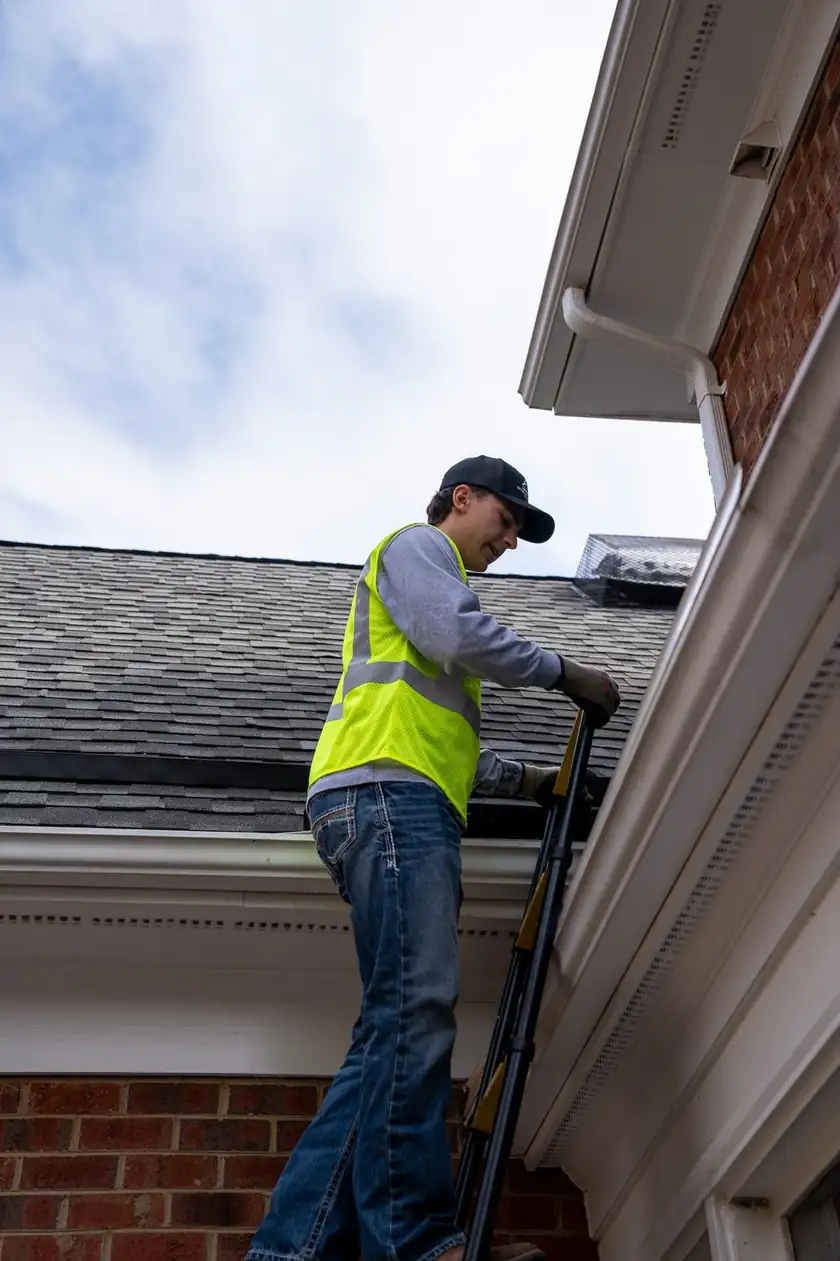
This guide is from Charlotte Premier Roofing. On a gutter replacement we hang seamless aluminum gutters formed on site, and we size the trough and the downspouts to the roof area feeding them. Below is how that sizing works with Huntersville's own rainfall numbers.
Does North Carolina require a certain gutter size on a house?
No. The 2024 North Carolina Residential Code for one- and two-family dwellings deletes the model code's roof drainage section, R801.3, so it sets no gutter rule for a house. The 2024 North Carolina Plumbing Code does size gutters, in Section 1106.6, but its scope exception sends detached one- and two-family dwellings and townhouses up to three stories to the residential code instead.
That leaves the plumbing code's table as the clearest published yardstick, not a legal minimum for your house. It is useful because it ties gutter size to the local rainfall rate, and the rainfall rate is the part that changes from town to town.
How hard does it rain in Huntersville?
NOAA puts Huntersville's 100-year, one-hour rainfall at 3.16 inches per hour. Its Atlas 14 precipitation frequency estimates, read at the town's coordinates (35.4108 N, 80.8429 W), give these intensities:
| Storm length | Expected about once in 10 years | Expected about once in 100 years |
|---|---|---|
| 5 minutes | 7.16 inches per hour | 8.94 inches per hour |
| 60 minutes | 2.28 inches per hour | 3.16 inches per hour |
The plumbing code sizes on "the 100-year hourly rainfall rate," or on other rates from approved local weather data, so 3.16 inches per hour is the number used in the rest of this guide. NOAA gives a 90% range of 2.85 to 3.42 around it. The 5-minute rows show why a gutter can still spill in a short, violent burst: for those few minutes the rain falls more than twice as fast as the hourly figure.
Should you get 5 or 6 inch gutters?
Measure the roof area that drains into the run, then compare. The code's Table 1106.6 lists the "horizontally projected roof area" each half-round gutter can serve, which means the footprint of that roof section seen from above, not its sloped surface. Dividing the table's 1-inch figures by Huntersville's 3.16 gives these ratings:
| Half-round gutter | Pitched 1/16 inch per foot | Pitched 1/8 inch per foot |
|---|---|---|
| 4-inch | about 456 square feet | about 646 square feet |
| 5-inch | about 791 square feet | about 1,114 square feet |
| 6-inch | about 1,215 square feet | about 1,722 square feet |
Two limits on that table. It covers half-round gutters only, and most houses carry the flat-backed K-style profile, which the table does not rate, so ask the installer which rating their profile uses. And it sizes one run at a time: a long back roof draining to one gutter is a different question from a short porch roof.
Upper walls add water too. For roof drains and leaders, the same chapter adds half the area of any wall that sheds rain onto the roof below it, which on a two-story house is the upper wall above a lower roof.
What size downspout goes with it?
By the code's Table 1106.2(2), a 2 by 3 inch rectangular downspout serves about 1,753 square feet of roof at Huntersville's 3.16 inches per hour, and a 3 by 4 inch about 4,180. Where the outlets go matters too.
A long run of roof feeding one small downspout at the far corner overflows at the first hard rain. That is why we look at each slope's area and put the outlets and the downspout sizes where they can carry it. Flat runs are the other cause: each run gets pitched toward its downspout, because a gutter hung flat holds standing water against the fascia.
Do gutters go behind the drip edge?
The gutter sits under the drip edge. A roof replacement puts new drip edge on the eaves, and the gutter has to sit under that edge, tight to the fascia, so water comes off the shingle and drops into the trough. When we do both in one job, that joint gets built once and the new gutters are not pulled off later to get at the roof.
Gutters come up in several of our Google reviews in the same sentence as the roof. One customer, Judy, wrote in her Google review: "Matt and his crew did an exceptional job. Great choices of shingles to choose from, and they replaced all of the gutters." Our post on replacing a roof and gutters together covers that decision.
Common questions
What are the standard sizes for roof gutters?
The North Carolina Plumbing Code's gutter table lists half-round gutters from 3 to 10 inches across, and the 5-inch and 6-inch sizes are the ones compared here. The table rates each size by the roof area it can drain at a given rainfall rate and pitch, so size alone does not settle it.
What is the rule of thumb for gutters?
In the state code's table, the roof area a gutter can serve falls in step with the rain rate: twice the rain, half the area. Pitch helps. At 1 inch of rain per hour, a 5-inch half-round gutter goes from 2,500 to 3,520 square feet when the slope rises from a sixteenth to an eighth of an inch per foot.
Should downspouts touch the ground?
A downspout should end in an extension that carries the water away from the house rather than stopping at the wall. On our gutter replacements, the downspout bottoms get extended away from the foundation, since a gutter that dumps at the wall moves the water problem into the crawlspace.
Start with the roof area
The right gutter for a Huntersville home comes from the roof area above each run, the pitch it is hung at and a rain rate near 3.16 inches per hour, not from a single size for the whole house. More on roofs and gutters in town is on our roofing in Huntersville page, and our Lake Norman wind and roof replacement post covers the roof itself.
Sources: all read November 18, 2026. NOAA National Weather Service, Atlas 14 Precipitation Frequency Data Server, Volume 2, Version 3, point estimates for 35.4108, -80.8429 (partial duration series). 2024 North Carolina Plumbing Code, Chapter 11, Storm Drainage (Sections 1106.1, 1106.2, 1106.4, 1106.6) and Section 101.2. 2024 North Carolina Residential Code, Chapter 8 (R801.3 deleted).